
Thursday, April 19, 2012
My Book Has Shipped

Daddy Loves Froggy
To the outside observer, it may seem that scientists hate frogs. Perhaps it's true. After all, they're green, slimy, and with a little salt they can enter zombie mode. That's probably not enough to justify dissection, but perhaps it's enough to justify this:
Now, I know what you're thinking. It's a frog. Levitating. In a magnetic field. WTF?!?!
Frogs aren't normally magnetic. However, frogs (and other living creatures) contain water, which is a diamagnetic material.1 Diamagnetic materials have this weird property that when you place them in a magnetic field, they turn into a magnet themselves. The new magnet points in the opposite direction of the first magnet. In this way, a diamagnetic material is like a magnet that always repels. Normally, this effect is very weak, but NASA scientists have shown that if you have a very big magnetic field, you can generate a magnetic force that is large enough to lift everyday objects like frogs.2 Now you might wonder why NASA cares about levitating frogs...
In truth, they've levitated more than just frogs. Their goal seems to be eventually levitating a human. This, of course, would be one way to mimic the effects of zero gravity. How large of a magnetic field would it take to lift a human?
According to Wikipedia, it takes about 16 Tesla of magnetic field to levitate a frog. For comparison, an MRI machine, which can erase all your credit cards if they're in the same room, has a magnetic field of 3 Tesla.
Now the magnetic field serves two purposes. First, it magnetizes our prospective astronaut. The amount he gets magnetized will be roughly proportional to the magnitude of the magnetic field. After magnetizing the astronaut, the magnetic field will then push him up with a force that depends on both its own value and the value of the astronaut's magnetization. Since the field appears twice in the force we can say that the force is proportional to the field squared:
A small frog might weigh 50 grams, which is roughly 1000 times smaller than a human. To get 1000 times the upward force, you'd need a field that's 32 times bigger. (You can see this by squaring 32 to get roughly 1000 times the force.) For this reason, you'd need a field that's about 500 Tesla, which is like having 170 MRI machines.
[1] Other diamagnetic materials include gold, silver, copper, carbon dioxide, and bismuth.
[2] For more info, click here.
Now, I know what you're thinking. It's a frog. Levitating. In a magnetic field. WTF?!?!
Frogs aren't normally magnetic. However, frogs (and other living creatures) contain water, which is a diamagnetic material.1 Diamagnetic materials have this weird property that when you place them in a magnetic field, they turn into a magnet themselves. The new magnet points in the opposite direction of the first magnet. In this way, a diamagnetic material is like a magnet that always repels. Normally, this effect is very weak, but NASA scientists have shown that if you have a very big magnetic field, you can generate a magnetic force that is large enough to lift everyday objects like frogs.2 Now you might wonder why NASA cares about levitating frogs...
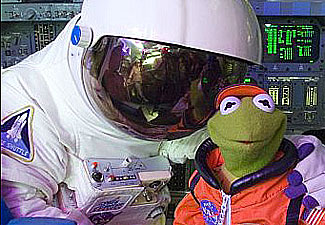 |
| Fr-fr-frogs...in-in-in...spa-spa-spaaaaaacce!!! |
In truth, they've levitated more than just frogs. Their goal seems to be eventually levitating a human. This, of course, would be one way to mimic the effects of zero gravity. How large of a magnetic field would it take to lift a human?
According to Wikipedia, it takes about 16 Tesla of magnetic field to levitate a frog. For comparison, an MRI machine, which can erase all your credit cards if they're in the same room, has a magnetic field of 3 Tesla.
Now the magnetic field serves two purposes. First, it magnetizes our prospective astronaut. The amount he gets magnetized will be roughly proportional to the magnitude of the magnetic field. After magnetizing the astronaut, the magnetic field will then push him up with a force that depends on both its own value and the value of the astronaut's magnetization. Since the field appears twice in the force we can say that the force is proportional to the field squared:
Force ~ (magnetic field)2.
A small frog might weigh 50 grams, which is roughly 1000 times smaller than a human. To get 1000 times the upward force, you'd need a field that's 32 times bigger. (You can see this by squaring 32 to get roughly 1000 times the force.) For this reason, you'd need a field that's about 500 Tesla, which is like having 170 MRI machines.
[1] Other diamagnetic materials include gold, silver, copper, carbon dioxide, and bismuth.
[2] For more info, click here.
Monday, March 19, 2012
Skewered Contest Winners!
Diary of Numbers history has been made. For the first time, we have a tied contest. Congratulations to our winners. They'll both receive a free signed copy of How Many Licks?
In this contest, we considered Skewes' number. At one time, Skewes' number was the largest number ever to appear in a mathematical proof. It can be written as
In this contest, we considered Skewes' number. At one time, Skewes' number was the largest number ever to appear in a mathematical proof. It can be written as
10101034.
What physical quantity comes closest to Skewes' number?
 |
| The Universe. Vastly smaller than Skewes' number. |
This is a very large number. As mentioned in the contest post, it's vastly bigger than the number of atoms in the solar system. To even come close, we're going to have to think on the scale of the universe. There have been about 1018 seconds since the big bang. Since the fastest rate at which information can travel is the speed of light, there's only a finite region of the universe that's observable. Anything outside this region is so far away that even light left over from the beginning of time hasn't had time to reach us yet. This distance will be equal to the speed of light times the age of the universe, roughly 1026 m. The total volume of the observable universe will be this cubed, or roughly 1078 m3. Notice our exponent is only 78. We need it to be 101034. We're not even close yet!
What if we measured using a smaller unit than meters? What is the smallest unit we could measure with? We could use the Planck length ~10-35, which is the length scale at which our conceptions of space start to break down. If we measure the size of the observable universe in Planck lengths, it would be about 10183 Planck lengths. That's still only an exponent of 183. We've barely scratched the surface.
What if we considered space-time rather than just space? Einstein's theory of relativity treats time as just another dimension. Just like space, there is a Planck time (10-44 s) at which our concept of time begins to break down. The universe is about 1062 Planck times old. This means there are about 10245 observable points in space-time. Again, we're still only scratching the surface of Skewes' number.
 |
| The number of possible universes is still smaller than Skewes' number |
Perhaps we should think about combinatorics. If we only consider universes that are the same size as our own, how many different possible universes can there be? According to particle physics, there are on the order of 10 fundamental particles (e.g., photons, electrons, quarks, etc.) If I consider only one point in space time, it has roughly 10 possible states corresponding to the different particles (or absence of particles) that can be found at that point. If there were only 2 points in space-time, there would be roughly 102=100 possible universes. For 10245 points in space time, there are roughly 1010245 = 1010102.4 possible universes. The third exponent 2.4 is still much smaller than the 34 that appears is Skewes' number. Even if we counted every possible universe, we'd still be very far away from Skewes' number!
Tuesday, March 13, 2012
Lessons from Stick Figures: Derivatives
More cheesy math/science cartoons. Voiced by Matthew Grace and Stacey Smith.
Saturday, March 3, 2012
On Being Enrico Fermi
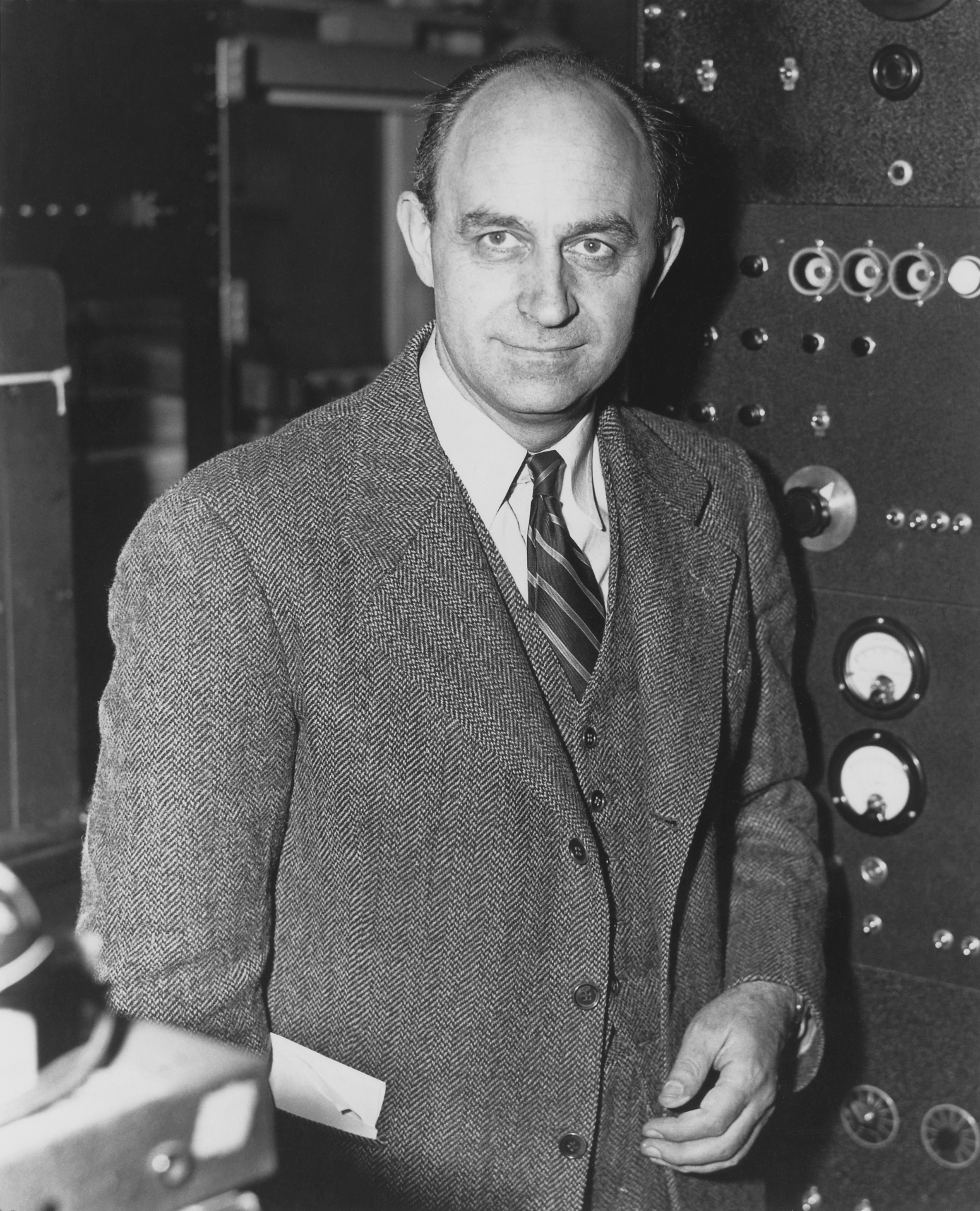 |
| Here's me in 1934. I have a lot more hair now. |
Wednesday, February 29, 2012
Measuring the Height of a Building with a Barometer
Here's a video made by my winter term students Sophia Chen, Kathryn Hasz, David Morris, and Jenny Schloss. The music is by the lovely and supremely talented Anna Lackaff.
Tuesday, February 28, 2012
Lessons from Stick Figures: Quantum Mechanics
Sometimes I make cheesy science cartoons. Here's one featuring the vocal talents of Matthew Grace and Stacey Smith.
Subscribe to:
Posts (Atom)

