Today’s question comes from this week’s special guest, Brian Pothier. In addition to being an NHL defenseman for the Washington Capitals, Brian may also be an amateur physicist. Perhaps without realizing it, Brian suggested a question that contains some fairly deep physics:
“How many pucks can you fit in a hockey net?”
The packing of three-dimensional geometric objects has been an on-going topic of research from antiquity to the present day1. Since we’re only concerned with an order of magnitude estimate, we won’t be treating this problem with the rigor that a mathematician might, but the odd shape of the goal makes finding a rigorous solution an interesting—or at the very least challenging—problem.
An official NHL hockey goal is 4 ft tall and 6 ft wide. As mentioned above, the back of the net has a funny shape, but it looks about 2 ft deep. This gives a total volume of ~1.4 m3 (42 ft3).
According to Wikipedia, a standard hockey puck is 1 in thick with a 3 in diameter giving a total volume of 116 cm3 (~7.06 in3). If we stack them on top of each other in a hexagonal pattern, they’ll consume about 90.7% of the volume2. From this and the volume above, we can compute the number of pucks that can fit in a net,
# of pucks = (packing fraction) · (vol. per net) · (vol. per puck)
= (0.907) · (1.4 m3) · (116 cm3)
= 9,300 pucks per net
That’s a lot of pucks, roughly equal to the number of goals that Brian’s team the Capitals have scored in their entire history. Alex Ovechkin would have to keep up his current scoring pace for 150 years to score that many goals. Thanks for the question, Brian!
[1] For more info on packing problems, you can check out this article or this one.
[2] This is equivalent to a packing circles in two-dimensions.
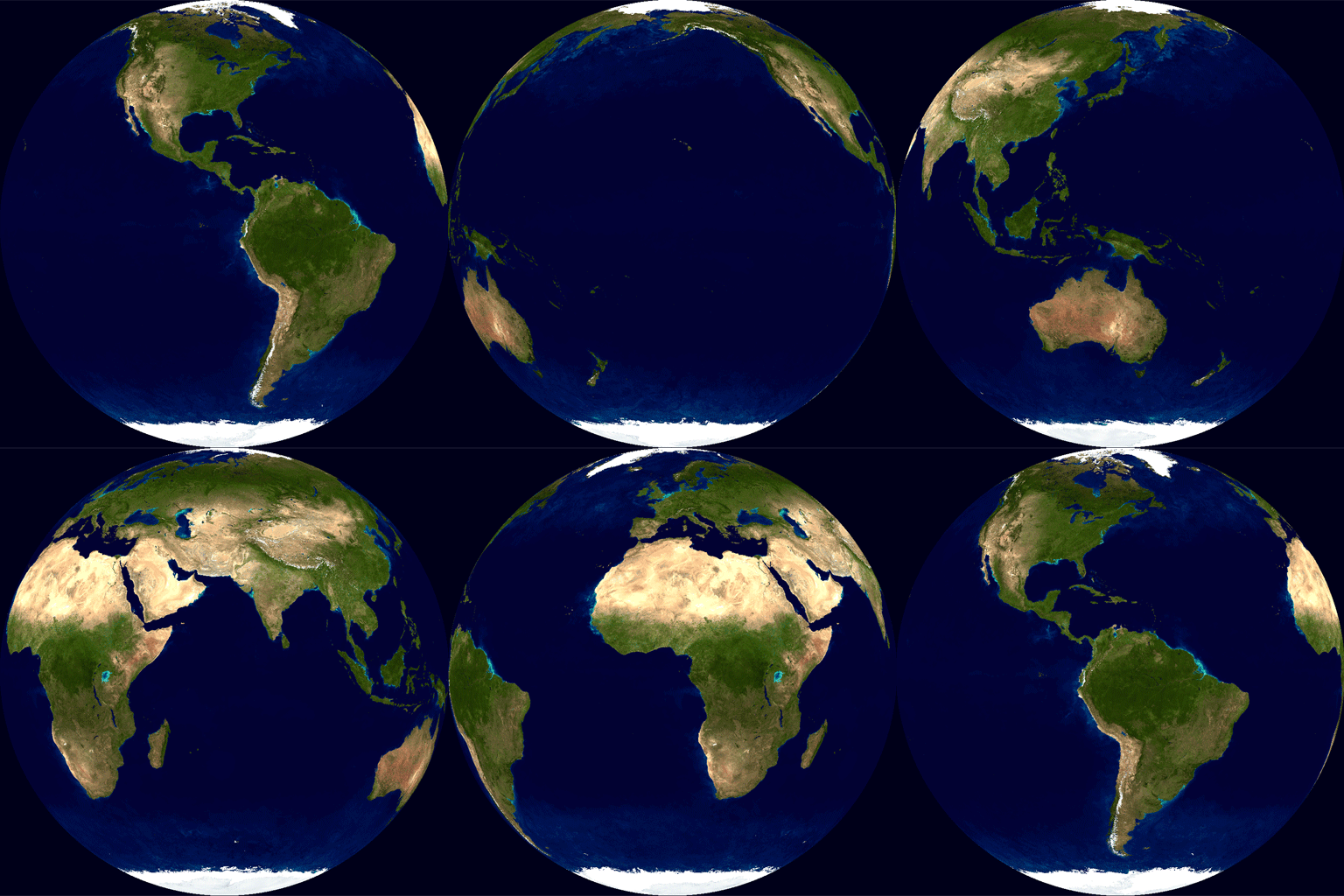
According to NASA scientists, our days are 1.26 microseconds shorter because of the Chilean earthquake. Apparently, this is fairly common. The magnitude 9.1 earthquake that caused the 2004 tsunami shortened the day by 6.8 microseconds. The length of the day decreases because the distribution of Earth’s mass changed and angular momentum must be conserved. The effect is similar to an ice skater rotating in a circle. As she pulls her arms in, she rotates faster. How much skinnier would the Earth have to get for the day to last only one second?
The angular momentum of a rotating body can be computed using the equation,
angular momentum = (moment of inertia) · (angular velocity).
Using the Earth’s mass (~5.97×1024 kg) and radius (6371 km), we can estimate its moment of inertia as being equal to that of a sphere,
moment of inertia = 2 · (mass) · (radius)2 / 5
= 2 · (5.97×1024 kg) · (6371 km)2 / 5
= 9.7×1037 kg m2.
The angular velocity of the earth is given by,
angular velocity = 2 · π /(period)
= 2 π /(1.0 day)
= 7.3×10⁻⁵ Hz.
From this, we can compute Earth’s angular momentum to be about 7.1×1033 kg m2/s.
If the day was only one second long, the new angular velocity would have to be 6.26 Hz. Using the fact that the angular momentum must remain the same, we can compute the new moment of inertia,
moment of inertia = (angular momentum) / (angular velocity)
= (7.1×1033 kg m2/s) / (6.26 Hz)
= 1.1×1033 kg m2.
For reasons that will be clear in a moment, we will set this equal to the moment of inertia for a cylinder (rather than a sphere) and solve for the cylinder’s radius,
To have a one-second long day, that Earth would become so skinny that it would start to look like a long cylinder. If it maintained the same density, it would now be 9.7×10⁸ km long, about 2.5 times the distance to the Moon.
If you’d like to help earthquake victims in Chile and Haiti, please visit the Red Cross.
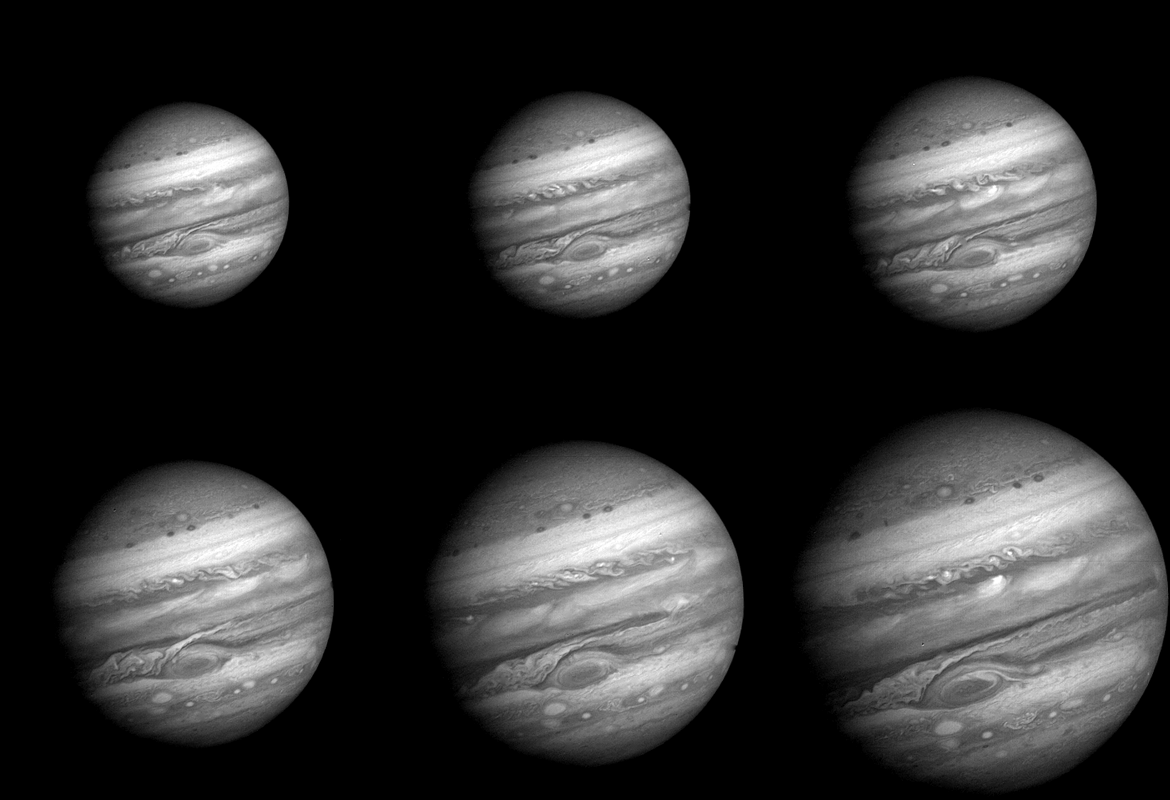
Two of my favorite themes to estimate are space travel and green energy. I view the two as related. With population growth, I think the only way we’re going to maintain the planet is if some of us get off of it. (Some people should probably leave sooner than others.) With that said, I really like Thomas’s question from the comments below: “If we built a farm of giant wind turbines in Jupiter's Great Red Spot, how much energy could they provide?”
According to Wikipedia, the Great Red Spot has lasted for at least 180 years and possibly as long as 345 years. Its measures 24–40,000 km west–to–east and 12–14,000 km south–to–north. To make life easy, I’ll assume the Spot is a circle 20,000 km in diameter. Air currents flow around the edges with a maximum rate of 120 m/s (432 km/h). Jupiter’s surface pressure lies within the range 20-200 kPa and its average temperature is 125 K = -148°C. If we assume the atmosphere is an ideal gas1, we can compute the number density using the equation,
number density = (pressure) / [ (Boltzmann’s constant) · (temperature) ]
= (100 kPa) / [ (1.38×10⁻²³ J / K) · (125 K) ]
= 6.0×1025 m-3.
This is the number density, i.e. the number of molecules in a cubic meter. Since most of Jupiter’s atmosphere is made of hydrogen gas, we can estimate the mass density by multiplying the number density by the mass of a single hydrogen molecule2,
mass density = (mass of H2) · (number density)
= (3.3×10⁻²⁴ g) · (6.0×1025 m-3)
= 0.20 kg/m3.
Wind turbines convert the kinetic energy of the wind into electric energy. I’ll assume the turbine’s blades are 45 m long, so that they sweep out an area of 6,400 m2. We can estimate the energy produced by using the formula,
power = (density) · (area swept by the rotor) · (speed of the wind)3 / 2
= (0.20 kg/m3) · (6,400 m2) · (120 m/s)3 / 2
= 1.1×10⁹ W
This is the total energy absorbed by the turbine, but not all of this will be converted into useable energy. If we assume the turbine is only 10% efficient, we’d end up with a total of 1.1×10⁸ W per turbine. As the phrase “per turbine” suggests, this is how much energy we’d get from only one wind turbine. Wind farms usually have multiple turbines running simultaneously. If we rigged one up every 100 m in a circle around the edge of the Spot, we’d have a total of 630,000 turbines. We could then compute the total amount of useable power,
total power = (# of turbines) · (power per turbine)
= (630,000 turbines) · (1.1×10⁸ W per turbine)
= 6.9×10¹³ W.
That’s enough energy to power 21 USAs. Although clearly an impractical solution to the energy problem, the sheer amount of energy makes it an intriguing option as an energy source. At the very least, it will hopefully make government officials think twice before slashing NASA’s budget.
Thanks, Thomas. This was a fun problem.
[1] Jupiter’s atmosphere is probably not an ideal gas, but this is a reasonable first estimate.
[2] You can calculate the mass of an H2 molecule by taking it molecular weight (~2.016 g/mol) and dividing by Avogadro’s number.
There's still plenty of time to enter the estimation contest. The winner gets a signed copy of How Many Licks?. Email your entries to “aaron at aaronsantos period com.”
As extra motivation, I’m posting this picture I found on reddit today. What can I say? It's a small Internet.
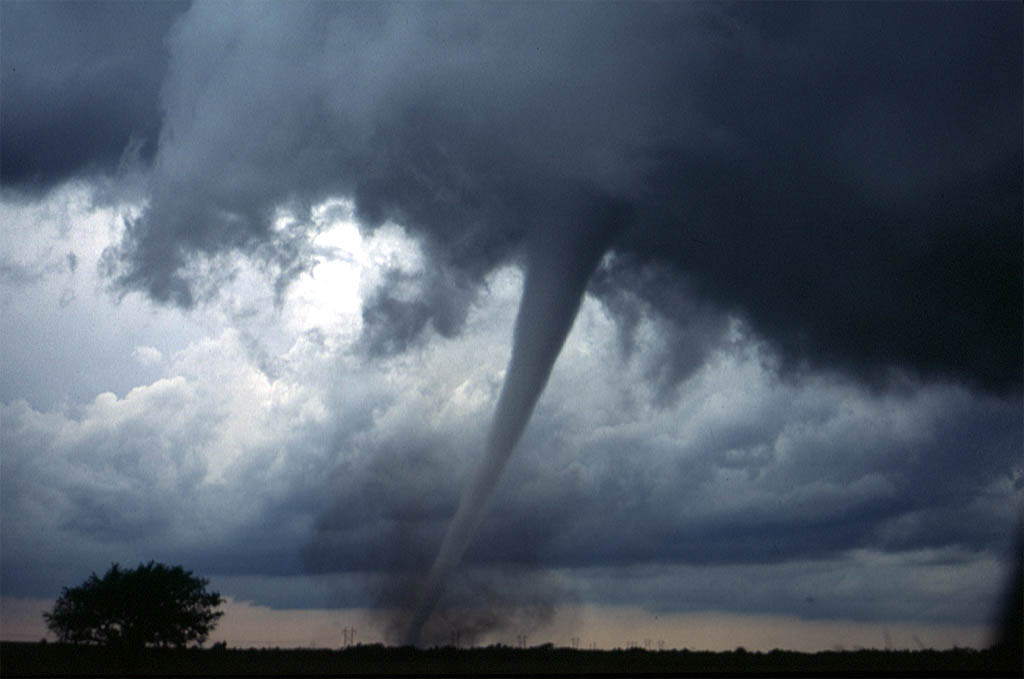
Tornadoes are a big problem in much of the United States. In addition to ruining homes, cleaning up after them can cost the government millions of dollars each year. Perhaps there’s a way to shoot them down before they do any damage. A tornado is basically a giant pocket of air rotating really fast. Any mass moving in a circle must be accelerating. An accelerating electric charge releases power in the form of electromagnetic radiation, i.e. light.1 In principle, if you dumped a bunch of electric charges into the tornado and let them spin around, the tornado should lose energy. How many charged pith balls would you need to fire at a tornado to sap all its energy out in one second?
To solve this problem, it helps to know some physics. In 1897, Joseph Larmor derived an equation2 for the power P emitted by a charge as it accelerates,
P = e2 a2 / 6 πε0 c3.
Here, e is the electric charge, a is the acceleration, π = 3.1415926... , ε0 = 8.85×10⁻¹² F/mis the permittivity of free space3, and c = 3.00×10⁸ m/s is the speed of light. Pith balls were one of the first materials used in an electroscope. Much like a balloon that you rub on your head, they can pick up a static charge. I’m imagining that we drop a bunch of pith balls onto a van de Graff generator to charge them and then fire them into the tornado. Pith balls can hold anywhere from 10-9-10-6 coulombs (C) of charge, so I’ll assume each one holds e = 10-8 C. To calculate how much power the charges will drain out, we need to know what their acceleration will be once they’re inside the tornado.
For simplicity, I’m going to assume the pith balls are light enough that they’ll be caught in the air stream and get flung around like Dorothy’s house in The Wizard of Oz. If that’s the case, then we can estimate the acceleration of the charges from the wind speed of the tornado. According to Wikipedia, tornados have winds between 64 and 177 km/h (~40-110 mph) and are approximately 75 m (~250 feet) across. They maintain contact with both the ground and a cumulonimbus cloud, meaning they can be anywhere from 150 to 3,960 m tall. To make things easy, I’ll assume the tornado is shaped like a 2000 m tall cylinder with a 75 m diameter and an outer edge that’s moving at a speed off 177 km/h. Since most of the pith balls will land somewhere in the middle of the tornado, they’ll be moving slower than the edges. I’ll assume that on average they’re traveling 100 km/h at a distance 20 m away from the center. From these numbers, we can estimate the acceleration of particles inside the tornado using the formula,
a = v2 / r
= (100 km/h)2 / (20 m)
= 39 m/s2.
By plugging this result into the Larmor formula, we can compute the power radiated by a single pith ball each second,
P = (10-8 C) 2 · (39 m/s2)2 / [6 π(8.85×10⁻¹² F/m) · (3.00×10⁸ m/s)3 ]
= 3.4×10⁻¹² W per pith ball.
To calculate how many pith balls we would need to kill the tornado in one second, we’d need to know how much kinetic energy is in the tornado. The rotational kinetic energy of a cylinder is given by,
KE = I ω2 /2,
where I is the moment of inertia for a solid cylinder and w is the angular velocity given by,
I = m r2 /2,
and,
ω = v / r,
respectively. The mass of the tornado can be calculated using the density of air (1.2 kg/m3) and the dimensions of the tornado to get a total mass of 1.1×10⁷ kg. From this and the equations above, we can solve for the rotational kinetic energy of a tornado,
KE = m v2 / 4,
= (1.1×10⁷ kg) · (177 km/h)2 / 4
= 6.6×10⁹ J.
From this number and the total power emitted by a single charged pith ball, we can compute how many pith balls we would need to stop the tornado in one second,4
# of balls = (energy) / [ (power per ball) · (time)]
= (6.6×10⁹ J) / [ (3.4×10⁻¹² W per ball) · (1 s)]
= 1.9×10²¹ pith balls
This number is huge. If each pith ball were a centimeter in diameter, they would fill up a cube 100 km on a side.5
[1] Since a charged tornado would emit light, you might wonder if actually doing this would look cool. In truth, the frequency of the light emitted will be about the same as the rotational frequency of the tornado. This would produce invisible radio waves.
[2] Rigorously speaking, this formula only works in vacuum. The main result won’t change, but in principle you should use the permittivity of air.
[3] The “F” here is short for “Farad”, a unit of electrical capacitance.
[4] To solve this correctly, you need more advanced mathematics since the acceleration of the charges will not be constant, (i.e. the charges will slow down as the tornado loses energy). It should be possible to get a better estimate using calculus.
[5] There’s another fundamental problem we haven’t considered. Namely, once you have a few pith balls in the tornado, it will be harder to get more in there since the charges will repel.
Hitchhiker: You heard of this thing, the 8-Minute Abs?
Ted: Yeah, sure, 8-Minute Abs. Yeah, the exercise video.
Hitchhiker: Yeah, this is going to blow that right out of the water. Listen to this: 7... Minute... Abs.
―Scene from There’s Something About Mary, as quoted on IMDB.
We turn now to weight loss. Forget “Eight-Minute Abs” and “Ten-Minute Buns,” we have something that’ll even eclipse Ben Stiller’s sketchy hitchhiker friend. How fast would you have to run to burn 10 lbs of fat in one second?
If we learned anything from the cannibal estimation, it’s that biology is not my strong suit. Be that as it may, there’s still a fairly straightforward way to at least estimate an upper bound for this problem. In order to lose fat, we have to convert it into energy. There are 9.0 Calories per gram or about 3.8×10⁷ J/kg in fat. That means there are about 1.7×10⁸ J of energy in 10 lbs (~4.53 kg) of fat.
When we run, we convert chemical energy into kinetic energy. Kinetic energy is the energy of motion and can be computed using the formula,
energy = (person’s mass) · (speed)2 / 2.
If we start from the stop position and accelerate to some speed, the chemical energy we use will be at least as big as our kinetic energy. Not all of the chemical energy gets converted to kinetic energy. Since our bodies aren’t 100% efficient, some of the chemical energy gets converted into heat. Moreover, not all of the kinetic energy helps us move forward, since we’re also using some of it to swing our arms and legs. In short, we use more chemical energy than we get out, but we can use this fact to compute an upper bound on how fast we’d need to run to lose 10 lbs in a second. I’ll assume the person’s mass is 75 kg (~165 lbs).1 We can solve the equation above for velocity to estimate the speed a person would need to run to lose 10 lbs in a second,
speed = [ 2 · (energy) / (person’s mass) ]1/2
= [ 2 · (1.7×108 J) / (75 kg) ]1/2
= 2100 m/s
If you neglect the sonic boom and air friction that would surely kill most mere mortals, you could lose at least 10 lbs in one second by accelerating to 2100 m/s, or about Mach 6 (i.e. six times the speed of sound).2
[1] This is technically the average mass since the person is losing mass as he runs.
[2] Before you start burning fat, you use the chemical energy from ATP and glycogen. Rigorously speaking, this means you might have to run a little faster. However, given that you’d likely deplete your ATP and glycogen storage well before you’d lose 10 lbs in a single workout, I stand by this result as an upper bound.
“Yay! It took all night, but I finally finished this term pappppppppppppppppp ppppppppppppppppppppppppppppppppppppppppppppppppppppppppppppp ppppppppppppppppppppppppppppppppppppppppppppppppppppppppp….”
Have you ever pulled an all-nighter only to sleep through the class for which your project was due? Ever worked so late you fell asleep facedown on your keyboard and then woke to an incoherent mess of random characters on the screen? If so, you probably had to delete quite a bit. How many incoherent characters would you accidentally type by using your keyboard as a pillow?
By holding down one key, you can gauge that a keyboard can type about 30 characters per second. If you get an average night’s worth of sleep (~8 hours), you’ll have held the key down for about 29,000 seconds. You can then compute the number of incoherent characters on the screen,
total # of characters = (# of characters per second) · (time)
= (30 characters per second) · (29,000 seconds)
= 870,000 characters.
You’d have close to one million characters, or about 200 single-spaced pages worth.
Well, it’s late. I should probably get some sleeppppppppp
 Today’s question comes from this week’s special guest, Brian Pothier. In addition to being an NHL defenseman for the Washington Capitals, Brian may also be an amateur physicist. Perhaps without realizing it, Brian suggested a question that contains some fairly deep physics: