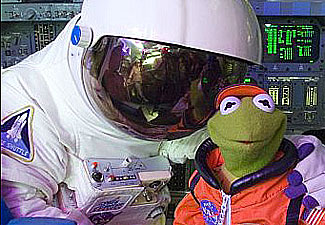
Many people dream of dropping out of school and running off to join the circus. Today's guest did just that (minus the dropping out of school part). Tanya Burka is an MIT graduate and circus artist currently performing the aerial silk act in Cirque Du Soleil's Quidam. Through her unique blend of science and athletic talent, Tanya has composed quite an impressive resume, one perhaps better-suited to an aspiring superhero or possibly a sexy James Bond villain.
Tanya Burka is the lone point of intersection in this Venn diagram.
Tanya writes,
It's not a circus-related question (or if it is, only tangentially in
that an elephant is referenced), but I've always wanted to know how many
ants it would take to lift an elephant, and whether or not it would be
possible in practical terms in having enough surface area on the
elephant at some angle (lying down, for example) for the ants to all
support his weight.
It's often said that ants can lift 50 times their own weight. Even if we assume this is true, there's still some ambiguity about exactly how much weight they can lift. There are over 12,000 species of ants spanning a wide range of sizes. For simplicity, I'll assume ants weigh 20 mg so that they can each hold 1.0 gram of weight. In contrast, an elephant can weigh anywhere from 100 kg (~200 lbs) as a newborn to 10,000 kg (~20,000 lbs) as a large adult. If we take 1000 kg as an average, we can estimate that it would require about one-million (106) ants to lift an elephant.
To fit that many ants under an elephant, you'll need a wide area. For this reason, it's better if we have the elephant lay on its side. With a shoulder height of about 3 m, we can estimate that the side of an typical elephant would have an area of about 4.5 square meters. This would mean each ant would need to fit in an area of about 4.5 square millimeters.
This result is a fair bit smaller than the ant we assumed originally, but it's closer than I would have guessed. It's just as well. Logistically, it would be a nightmare trying to lay the elephant down exactly evenly over all the one-million ants before they could get away.
Today's special guest is biologist/bioengineer Joanne Manaster. In addition to lecturing at the University of Illinois-Urbana, Joanne does great science promotion through her blog Joanne Loves Science. She writes, "How about you do a more thorough answer to my 'Cats in Sinks' video?"
The video, which illustrates the differences between theoretical and experimental work, asks, "How many cats can fit in a sink?"
If you've ever tried to fit all your personal belongings in a small U-Haul, you're familiar with the packing problem. In its most basic form, the problem asks "How many X can you fit in a space Y?" The packing of irregularly-shaped objects has been studied since antiquity, and there's a lot of physics involved. Current research on packing has applications in cancer treatment, secure wireless networks, microelectronics, demolitions, and apparently putting cats in sinks.
Cats are certainly no strangers to packing themselves in tight places, and there are many ways to determine just how tightly they can pack themselves. For example, cats are about as dense as water, so you could weigh the cat and use this density to find its volume. A less scrupulous way of accomplishing the same goal would be to use a blender, but this inevitably leads to some cat juice slipping through the drain and throwing off the final number.
Since I don't have an experimental budget or a team of lawyers to defend me from animal cruelty charges, I'm going to tackle this problem theoretically. Very theoretically.
You may have heard of Schrödinger's "Cat in a Box." It's a quantum mechanical thought experiment, but here we'll be using a relativistic cat in box. According to Einstein's theory of relativity, the length of a moving object contracts as it goes faster and faster. For velocities in our everyday experience, the effect is too small to notice unless we make a very precise measurement. The effect is, however, very noticeable for objects moving close to the speed of light. According to Einstein, a moving object's length contracts by a factor of
f = (1 − v2/c2)1/2,
where v is the speed of the object and c = 3×10⁸ m/s is the speed of light. If 10% of people in the world have cats, there would be roughly one-billion (~109) cats. These cats could fit quite comfortably in a rocket ship that was one-billion meters long. For this rocket ship to fit in the sink, it would need to contract by a factor of about three billion (f = 3.0×10⁻¹⁰). Solving for the velocity, we find that every cat in the world could fit in the sink if they were loaded on a rocket ship traveling with a speed
v = 99.999999999999999995% the speed of light.
Since this rocket ship is essentially traveling at the speed of light, the cats would, admittedly, not remain in the sink very long. While you might think that cats moving at the speed of light would suffer just as much as the cat in a blender, I assure you they remain quite comfortable. According to relativity, the cats (in their own frame) remain the same size as normal and go about as usual, blissfully unaware that they're traveling at the speed of light. For them, it is the sink and the rest of the world that is contracted. I'll leave it to the reader to see if he/she can resolve the seeming paradox of how one-billion cats can fit in a contracted sink.
Rarely do I get the opportunity to answer a question that involves relativity, hypothetical animal cruelty, and cats. Thanks, Joanne. The internet should be pleased. To find out more about Joanne, visit her blog or follow her on twitter @sciencegoddess.
Today's question comes from special guest Sarah Donner. Sarah is a very talented indie folkpop singer/songwriter whose lovely voice can be heard in various places around the interwebs. Recently, she's been found singing the praises of pterodactyls on The Oatmeal.1
Sarah would like to know, "How many lightening bugs could a pterodactyl eat?"
According to at least one source, Lampyridae, commonly called lightening bugs or fireflies, have only been around since the Eocene epoch about 56 million years ago.2 In contrast, pterosaurs died off at the end of the CretaceousPeriod 65.5 million years ago. Pterodactyls in particular existed about 150 million years ago, so it seems like they missed each other by about 100 million years. Still, if they crossed paths, I'm sure the glow bug would have made a tasty treat.
"No!!! Don't eat me!!!"
Adult pterodactyls have an estimated wing span of about 1.5 m. That's about the same wingspan as a fruit bat. Assuming they have similar weights, that would put the pterodactyl at about 1.5 kg. He probably eats about 10% of his weight each day, meaning he'd consume 150 grams of food. Assuming lightening bugs weigh roughly 10 mg, a pterodactyl could consume about 15,000 lightening bugs over the course of one day.3 According to the song, the pterodactyl "ate 10,000 lightening bugs", a very good estimate indeed. Well done, Sarah!
To find out more about Sarah, you can visit her website or follow her on Twitter.
[1] Just a warning, the lyrics are not safe for work.
[2] We know this because you can find fossils of insects trapped in amber.
[3] I suppose one could instead consider the maximum number of lightening bugs a pterodactyl could eat if he kept going non-stop. According to Donald R. Griffin's Echos of Bats and Men, bats can catch a mosquito once every 6 seconds. Assuming pterodactyl have a similar catch rate (unlikely since they probably don't have a bat's echolocation abilities) and a lifespan of 20 years, a pterodactyl could have eaten 100 million lightening bugs.
Here's how it works. I’m posting a Fermi question below. To enter,
estimate an answer and send it to “aaron at aaronsantos period com.” If
your answer is closest to mine, I'll mail you a free signed copy of Ballparking.1Second prize receives a signed copy of my other book, How Many Licks? Or How to Estimate Damn Near Anything. Submit your entry on or before June 1, 2012. Don't worry…I won't
spam you or share your email with any third parties. Here's the question:
When I was a teen, my cousin Nick (who makes a brief appearance in Ballparking) and I used to play home run derby at a baseball field on Sconticut Neck. Being two years older, I had quite the height/strength advantage and would typically crush him into a metaphorical bloody pulp. However, once we hit our early 20's, I noticed a striking change. All of a sudden, the pulp into which I was beating him was dramatically less bloody. In fact, it was not even much of a pulp:
Me:Why am I sweating? And what the hell's wrong with the score board? It says I'm losing!!!"
Here's the field we played on.
Being a teen has a way of disillusioning you into thinking you'll always have a 32-inch waist and be stronger than people that are younger than you. This is, of course, not the case. Now that I'm in my 30's my match-ups with Nick have become decidedly one-sided in the opposite direction, and now the vast majority of blood in the pulp is my own. Fortunately, I still have cognitive dissonance and a healthy dose of wind blowing in from right field. You see, being on The Neck, the winds tend to blow in off the water. As a left-handed hitter, I'm at somewhat of a disadvantage to my right-handed cousin. I've seen (or at least convinced myself that I've seen) some of the tennis balls that I hit go over the fence only to be blown back onto the field. How fast (in mph) must the wind be to blow a ball back onto the field after it's gone over the fence?
[1] NOTE:
I make no pretenses that my answer is correct or even close. Your
answer may very well be a better estimate than mine. In fact, your
estimate may even be exactly right and you still may not win the contest
if somebody else's answer is closer to mine. Sorry about that. This is
the best way I could come up with to pick a winner and I'm not changing
it now. Like any good game, there's an element of luck required even if
you do have great skill. With that disclaimer out of the way, good luck
and happy calculatings!
My book is now officially available! Every time you buy a copy, your favorite sports team gets a win. Also your rival sports team gets mauled by bears.
To the outside observer, it may seem that scientists hate frogs. Perhaps it's true. After all, they're green, slimy, and with a little salt they can enter zombie mode. That's probably not enough to justify dissection, but perhaps it's enough to justify this:
Now, I know what you're thinking. It's a frog. Levitating. In a magnetic field. WTF?!?!
Frogs aren't normally magnetic. However, frogs (and other living creatures) contain water, which is a diamagnetic material.1 Diamagnetic materials have this weird property that when you place them in a magnetic field, they turn into a magnet themselves. The new magnet points in the opposite direction of the first magnet. In this way, a diamagnetic material is like a magnet that always repels. Normally, this effect is very weak, but NASA scientists have shown that if you have a very big magnetic field, you can generate a magnetic force that is large enough to lift everyday objects like frogs.2 Now you might wonder why NASA cares about levitating frogs...
Fr-fr-frogs...in-in-in...spa-spa-spaaaaaacce!!!
In truth, they've levitated more than just frogs. Their goal seems to be eventually levitating a human. This, of course, would be one way to mimic the effects of zero gravity. How large of a magnetic field would it take to lift a human?
According to Wikipedia, it takes about 16 Tesla of magnetic field to levitate a frog. For comparison, an MRI machine, which can erase all your credit cards if they're in the same room, has a magnetic field of 3 Tesla.
Now the magnetic field serves two purposes. First, it magnetizes our prospective astronaut. The amount he gets magnetized will be roughly proportional to the magnitude of the magnetic field. After magnetizing the astronaut, the magnetic field will then push him up with a force that depends on both its own value and the value of the astronaut's magnetization. Since the field appears twice in the force we can say that the force is proportional to the field squared:
Force ~ (magnetic field)2.
A small frog might weigh 50 grams, which is roughly 1000 times smaller than a human. To get 1000 times the upward force, you'd need a field that's 32 times bigger. (You can see this by squaring 32 to get roughly 1000 times the force.) For this reason, you'd need a field that's about 500 Tesla, which is like having 170 MRI machines.
[1] Other diamagnetic materials include gold, silver, copper, carbon dioxide, and bismuth.
[2] For more info, click here.