Monday, March 19, 2012

Skewered Contest Winners!

Diary of Numbers history has been made.  For the first time, we have a tied contest.  Congratulations to our winners.  They'll both receive a free signed copy of How Many Licks?

In this contest, we considered Skewes' number.  At one time, Skewes' number was the largest number ever to appear in a mathematical proof.  It can be written as

10101034.

What physical quantity comes closest to Skewes' number?

The Universe.  Vastly smaller than Skewes' number.
This is a very large number.  As mentioned in the contest post, it's vastly bigger than the number of atoms in the solar system.  To even come close, we're going to have to think on the scale of the universe.  There have been about 1018 seconds since the big bang.  Since the fastest rate at which information can travel is the speed of light, there's only a finite region of the universe that's observable.  Anything outside this region is so far away that even light left over from the beginning of time hasn't had time to reach us yet.  This distance will be equal to the speed of light times the age of the universe, roughly 1026 m.  The total volume of the observable universe will be this cubed, or roughly 1078 m3.  Notice our exponent is only 78.  We need it to be 101034.  We're not even close yet! 

What if we measured using a smaller unit than meters?  What is the smallest unit we could measure with?  We could use the Planck length ~10-35, which is the length scale at which our conceptions of space start to break down.  If we measure the size of the observable universe in Planck lengths, it would be about 10183 Planck lengths.  That's still only an exponent of 183.  We've barely scratched the surface.  

What if we considered space-time rather than just space?  Einstein's theory of relativity treats time as just another dimension.  Just like space, there is a Planck time (10-44 s) at which our concept of time begins to break down.  The universe is about 1062 Planck times old.  This means there are about 10245 observable points in space-time.  Again, we're still only scratching the surface of Skewes' number.  
The number of possible universes is still smaller than Skewes' number

Perhaps we should think about combinatorics.   If we only consider universes that are the same size as our own, how many different possible universes can there be?  According to particle physics, there are on the order of 10 fundamental particles (e.g., photons, electrons, quarks, etc.)  If I consider only one point in space time, it has roughly 10 possible states corresponding to the different particles (or absence of particles) that can be found at that point.  If there were only 2 points in space-time, there would be roughly 102=100 possible universes.  For 10245 points in space time, there are roughly 1010245 = 1010102.4 possible universes.  The third exponent 2.4 is still much smaller than the 34 that appears is Skewes' number.  Even if we counted every possible universe, we'd still be very far away from Skewes' number!


Tuesday, March 13, 2012

Lessons from Stick Figures: Derivatives


 More cheesy math/science cartoons.  Voiced by Matthew Grace and Stacey Smith.

Saturday, March 3, 2012

On Being Enrico Fermi

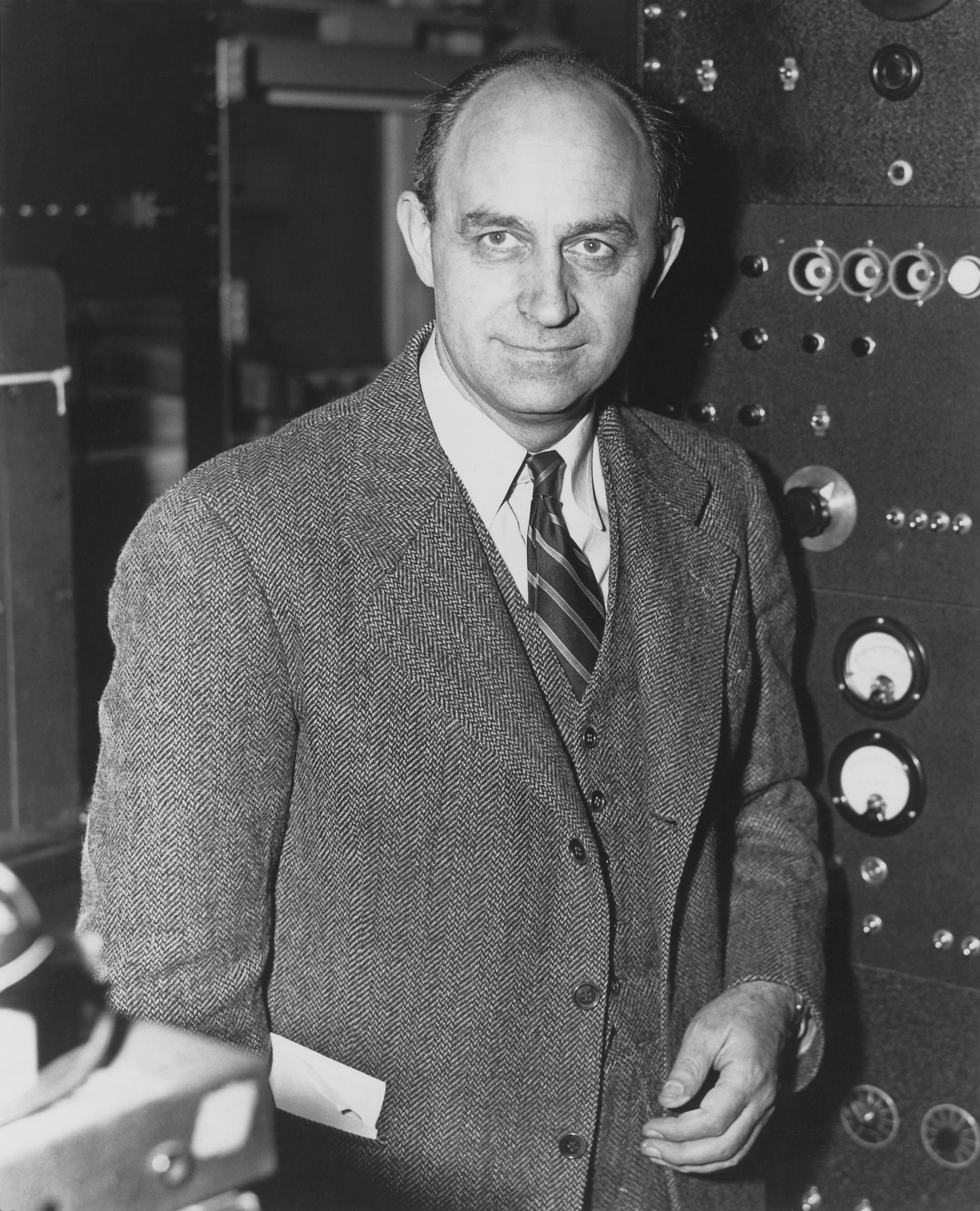
Here's me in 1934.  I have a lot more hair now.
Apparently, I am now officially Enrico Fermi. If you know of any physics departments looking to hire a Nobel laureate at a reasonable price, please direct them to inquire within.

Wednesday, February 29, 2012

Measuring the Height of a Building with a Barometer

Here's a video made by my winter term students Sophia Chen, Kathryn Hasz, David Morris, and Jenny Schloss.  The music is by the lovely and supremely talented Anna Lackaff.


Tuesday, February 28, 2012

Lessons from Stick Figures: Quantum Mechanics

Sometimes I make cheesy science cartoons.  Here's one featuring the vocal talents of Matthew Grace and Stacey Smith.


Learning Chinese

I love my dad.  Sometimes I forget how cool he can be.  Like all parents, there are times he embarrasses his kids, but every once in awhile he does something amazing.

About 12 years ago, my dad came up to visit me in college.  Like many college age students, I didn't always enjoy introducing my parents to friends because of the fear they might reveal some embarrassing childhood story or shame me in some other way.  For this reason, I told my dad to meet me downstairs in the dorm lobby, thinking this would minimize the potential for an embarrassing moment.  Imagine my horror, when, after arriving and meeting the cute Asian student sitting behind the front desk, my dad started speaking what appeared to be mock-Chinese gibberish at her.  The feeling was something akin to what I imagine ESPN's editors experienced after reading the racist Jeremy Lin headline earlier this month.  Much to my surprise, the student in question was not at all offended and instead returned the remark with a laugh and a response in Mandarin.  My dad, perhaps seeing the look of shock and unease on my face, smiled, put his hand on my shoulder, and continued conversing with her.  It was only then that I remembered my dad used to be a Chinese translator in the United States Air Force.

To this day, I don't know exactly what my dad said, but he seemed to make a good impression.  Now every time I get a fortune cookie at a restaurant, I look at the Chinese word on the back and wonder if I'll ever be able to speak with him in Chinese.  How much would I have to spend on Chinese food to learn every word?

Like any language, specifying the exact number of words is tricky.  Words are constantly being invented (and sometimes removed) from usage.  However, judging by the size of the Chinese-to-English dictionaries I've seen in book stores, I would assume the number of Chinese words is roughly equivalent to the number of English words, which would put the exact number somewhere in the vicinity of 100,000 words.  Assuming Chinese words are uniformly represented in fortune cookies, I would need to buy at least 100,000 meals.  At about $10 per meal, this would mean spending at least $1 million on Chinese food, and that's assuming I never got the same word twice (a very unlikely proposition.)  If I ate Chinese food every day for breakfast, lunch, and dinner, this would still take 91 years.  Needless to say, it may take awhile before I can speak to my dad in any language but English.

Wednesday, February 1, 2012

Skewered Contest!!!

Yay!  We have a new contest.  The rules are a little different from previous DON contests, but you can still win a free copy of How Many Licks?  Here's how it works. I’m posting a numbers question below. To enter, come up with an answer and send it to “aaron at aaronsantos period com.” If I think your answer is the best, I'll mail you a free signed copy of How Many Licks? Submit your entry on or before March 15, 2012 for consideration. Don't worry…I won't spam you or share your email with any third parties. Here’s the question:

I was reading an Asimov book the other day and came across something called Skewes' number.  At one time, Skewes' number was the largest number ever to appear in a mathematical proof.1  It would be impossible to write Skewes' number out in the conventional way, but using exponents we can write it as

10101034.

This is an exceedingly large number.  It is vastly bigger than the number of grains of sand in the Earth.  In fact, it's vastly bigger than the number of grains of sand in the solar system.  In fact, it's vastly bigger than the number of atoms in the solar system.  In fact, all of these physical quantities are extreme underestimates of Skewes' number.  What physical quantity comes closest to Skewes' number?

 Note: It must be something physical like a molecule, atom, or grain of sand (i.e. not something abstract like a number appearing in a mathematical proof.)

[1] It has since been replaced by other large numbers.  For more info, see Graham's number and Moser's number.