Wednesday, January 12, 2011

Tuesday, January 11, 2011
Plague Gauge
"This is what the LORD says: By this you will know that I am the LORD: With the staff that is in my hand I will strike the water of the Nile, and it will be changed into blood. The fish in the Nile will die, and the river will stink; the Egyptians will not be able to drink its water."

— Exodus 7:17–18
Eeeew! How many people would it take to make a river of blood?
According to the Wikipedia, the Nile discharges 2830 m3 of water each second. You'd need an equivalent flow rate of blood to produce a Nile-sized river. According to the American Red Cross, you can give 1 pint of blood once every 56 days. To produce a river worth of blood, you would need a total of
According to the Wikipedia, the Nile discharges 2830 m3 of water each second. You'd need an equivalent flow rate of blood to produce a Nile-sized river. According to the American Red Cross, you can give 1 pint of blood once every 56 days. To produce a river worth of blood, you would need a total of
# of people = (flow rate required) / (flow rate per person)
= ( 2830 m3/s ) / ( 1 pint / 56 days )
= 2.9 ×10¹³ people.
= ( 2830 m3/s ) / ( 1 pint / 56 days )
= 2.9 ×10¹³ people.
That's 4000 times more people than there are in the world today.
2011
Unlike plants, cats, or small children, this numbers blog doesn't complain when I don't feed it for two months. Still, I've been feeling bad about not posting, so my New Years resolution is to start writing regularly again. More to come in a moment...
Tuesday, November 16, 2010
Death By Coconut
 In “I Know What You Did Last Summer of the Shark”, then Daily Show correspondent Stephen Colbert states that falling coconuts kill 150 people each year. You might assume that “death by coconut” was a purely random occurrence, but that might just be what the coconuts want you to believe. What's are the chances that the coconuts are out to get you?
 According to Wikipedia, 54 million tonnes of coconuts were produced in 2009. From this, we know that if each coconut weighs 10 lbs, then roughly 1.0×10¹⁰ coconuts were produced. Now, we could quibble about the actual number. Some grow in the wild which might make the actual number larger. Some coconuts are picked instead of falling, so that might make the actual number smaller. You can argue either way, so let’s stick with this figure just to keep the problem relatively simple.
There are 6.7×10⁹ people in the world, each of which has about 1.5 ft2 of area that the coconut could land on giving a total area of about 1.0×1010 ft2. According to Wikipedia, the total land area in the world is about 1.5×10⁸ km2. If people are randomly distributed across the land area of Earth, then the probability of being hit by a coconut is equal to the fraction of land area that people take up at any given time. Using Google’s calculator, we get

It’s difficult to say how many people actually get killed by coconuts. From our calculation above and the world population, we can estimate the number of people that get hit by coconuts each year, but not everyone who gets hit from a falling coconut will be killed by it. Assuming all hits were fatal, we could calculate the total number of deaths by multiplying “hits per person” times the “total number of people”, to get
(6×10⁻⁶ hits per person) × (6.7×10⁹ people) = 40,000 fatal hits.
If hits are only fatal 1% of the time, then 400 people will die from coconuts falling. However, this 1% statistic may be off substantially—possibly much more than an order of magnitude—so our estimate is very rough.
It’s difficult to tell how many coconut-induced fatalities will occur, but our estimate of “40,000 coconut hits” suggests that the number of deaths could be substantially higher than 150. If this were the case, then coconuts are certainly not out to get you since they kill fewer people than they would by chance.
We’ve assumed the following:
· The mass of all the falling coconuts in the world each year is equivalent to the mass of coconuts produced each year.
· The probability of a falling coconut hitting a person is equal to the fraction of land area taken up by people.
· Only 1% of coconut hits are fatal.
These assumptions seem reasonable, but that does not mean they are necessarily correct. Coconuts are certainly between 1 and 100 lbs, so the first assumption seems decent. It’s possible the number of falling coconuts each year is off for the reasons stated above. Likewise, the percentage of fatalities could be off by several orders of magnitude. Equating the probability of a falling coconut hitting a person to the fraction of land area taken up by people is a reasonable first guess, but there are factors that might throw this assumption off. For example, perhaps more people live near coconut trees because people like to live in tropical climates.
While our estimate doesn’t have enough precision to answer this question conclusively, this example does illustrate an important point. As Weinstein and Adams describe in their book Guesstimation, estimates generally break up into three “Goldilocks” catagories: too big, too small, and just right. In this case, being “just right” means your estimated result is too close to call. When this happens, you need to put more effort into refining your estimate if you want to draw any conclusions. Refining the coconuts estimate to high precision is beyond the scope of what I can do in a silly blog post, but there is still a valuable lesson to be learned: In estimation as in life, there are times when even the best answer leaves a wide degree of uncertainty and it’s important to acknowledge when we don’t have enough information to draw a conclusion. That said, there are many examples where a test produces results that are so unlikely we can conclude they are not due to random chance.
Sunday, October 24, 2010
Lucky Numbers
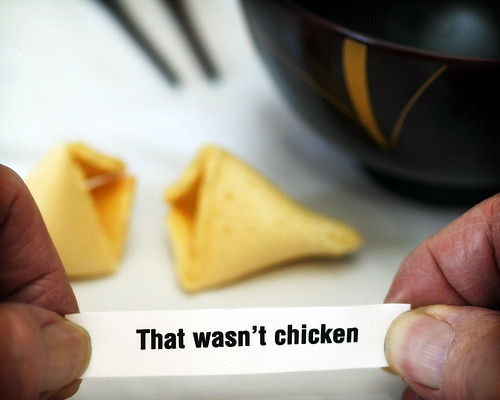
Both fortune cookies and lottery numbers usually show about 5 numbers that can range from roughly 1 to 50. The probability of picking the first number correctly is 5 out of 50. The probability of picking the second number correctly is 4 out of 49. The probability of picking the third number correctly is ... Multiplying these probabilities together, we can find the total probability of finding the right sequence of numbers1,
P = [(5)! · (50-5)!] / 50! = 4.7×10⁻⁷.
That's about one in two million. I generally go out for Chinese food about once per month, which seems like a reasonable amount for most people. Taking that as the average and using the fact that there are 3.0×10⁸ Americans, we can estimate the number of people that went out for Chinese today,
# of people going for Chinese = (prob. of going out for Chinese) · (total # of people)
= (1 day / 30 days) · (3.0×10⁸ people)
= 1.0×10⁷ people.
1 - (1-P)10,000,000
= 0.009.
There's about a 1% chance that if everyone played their lucky fortune cookie numbers at leat one would win.
[1] This is the well known binomial distribution.
[2] I'm assuming the fortune cookie's "lucky numbers" are random and uniformly distributed.
Sunday, October 17, 2010
Special Guest Natalie Angier

Before I begin, I have leaf-raking riddle for you. Without adding or rearranging the words, add punctuation to the following sentence to make it grammatically correct: "A boy raking leaves." The answer is below.
If you're going to rake leaves, you need leaves to rake. Some states like Arizona are desert-y and won't have many leaves to rake, but most places in the U.S. will have trees that shed. Even if you live in the right climate, you still need a yard with at least one tree in it. I'll assume that 1 out of 10 people owns a yard with a tree in it, since it's very likely that the actual number is greater than 1 out of 100 and less than 1 out of 1. Of these people, some will rake, but many will use a leaf blower or just let the leaves lie. Using a similar order-of-magnitude argument to the previous one, I'll assume 1 out of 10 people who have leaves rake them. The average leaf raker might rake his/her leaves once in October, and there are about 8 good leaf-raking October weekend afternoons each year. There are 3.1×10⁸ people in the United States. Combining these assumptions, we can estimate that,
# of people raking = (3.1×10⁸ people) · (0.1 tree owners per person)
· (0.1 raker per tree owner)· (0.125 chance of raking now)
· (0.1 raker per tree owner)· (0.125 chance of raking now)
= 390,000 people raking leaves each weekend afternoon in October.
But the question specifically asked for the number of leaves raked. This will clearly depend on the number of leaves a person has in his/her backyard. According to at least one source, a mature tree can have up to 200,000 leaves. To confirm this, I looked at leaves strewn across Tappan Square in Oberlin. The mean separation was about 6 inches between leaves. If you spread them out over a reasonably sized lawn (about 1/5 of an acre), you get about 200,000 leaves. If each raker rakes this many leaves one a weekend, there will be,
# of leaves = (200,000 leaves per raker) · (390,000 raker)
= 7.8×10¹⁰ leaves raked.
That's 78 billion leaves raked nationwide each afternoon in October. Thanks for the great question, Ms. Angier!
For those wondering about my earlier grammatical riddle, the correct answer is "A boy, raking, leaves."
Thursday, October 14, 2010
A Relatively Good Calculation

According to special relativity, the length of a moving object is equal to its original length times an extra factor
L' = L [1 – (v/c)2]0.5.
Here, c is the speed of light, L' is the length of the object when it's moving, L is the length of the object when it's not moving, and v is the velocity at which it's moving. Our new length L' will be about 10-10 m or roughly the size of an atom. Our original length will be about 1.5 m. We can solve for v
v = c [1 – (L'/L)2 ]0.5
= (3.0×10⁸ m/s)[1 – (10-10 m / 1.5 m)2 ]0.5
= 0.9999999999999999999977778 c.
You would need to move very close to the speed of light to be atom sized.
[1] This phenomenon is called "length contraction".
Subscribe to:
Posts (Atom)
