Monday, September 12, 2011

Mission Improbable


I watched Mission: Impossible yesterday and was reminded of two things: (1) there was a time when people thought Tom Cruise wasn't crazy and (2) there was a time when people thought the internet was.  Long before anyone dreamed of Facebook, Twitter, or rage comics, the internet was a pretty novel concept, and many people, myself included, weren't ready to dive in head first.  I haven't thought about this for awhile, but I'm pretty sure Mission: Impossible was the reason I decided to get a computer.  After all, if super spies used the internet, then it was probably pretty darn cool.  Who knows?  If I hadn't seen it, maybe I wouldn't be blogging this now.1  Still, there's one thing that bugged me in my second viewing.  In the iconic scene where Cruise is dangling from a rope while trying to steal sensitive government data, an alarm will go off and ruin the mission if he touches the floor, makes a sound, or raises the temperature of the room by 1° F.  There were a few close calls on these fronts, but I was particularly skeptical of the temperature restriction.  How long would it take your body heat to raise the temperature of the room by 1° F?

Human bodies release heat at a rate of about P = 100 W.2  This heat will spread throughout the room, which has a volume of roughly 15 ft by 15 ft by 30 ft = 200 m3.   With a density of 1 kg/m3, the total mass of air in the room will be about m = 200 kg.  The specific heat of water is about c = 1 J/g·K.  From this we can fin the time it will take to raise the room by 1° F (~0.6 K),  


 t = m c ΔT / P
= (200 kg) · (1 J/g K) · (1° F) / (100 W)
= 20 minutes.

Apparently, they would have time as long as they were fairly quick about it.3

[1] Admittedly, if I had never seen the movie, I couldn't be writing this post right now, but you get the idea.
[2] See the post titled "Igloos Rock!"
[3] I've neglected the fact that the room is temperature controlled.  As the temperature rises, the temperature control will turn on the AC to return it to normal.  This may have given them even more time.

Monday, August 29, 2011

And That's the Tooth

Yes, I watch absolutely terrible movies.
While watching Family Guy the other day, I saw this.  The Tooth Fairy has been played by everyone from Eddie Murphy to The Rock, but this one got me thinking: How many teeth does the Tooth Fairy collect each year?1

Humans are born with 20 baby teeth.2  Since you live about 80 years, your rate of tooth loss is about

(20 teeth per person) / (80 years)
= 0.25 teeth / year · person.

Not all of the world believes in the Tooth Fairy, so it's a safe bet that she doesn't visit every newly gap-toothed child.  Assuming only 10% of the world (roughly 700 million people) have been visited by the Tooth Fairy, then the total number of teeth that have been collected this year would be

(10%) · (1 year) · (700 million people) · (0.25 teeth / year · person) = 1.8×10⁷

That's 18 million teeth, or roughly enough teeth to fill a refrigerator. Apparently, our cartoon Tooth Fairy is fairly accurate.


[1] In case you're wondering, most of my inspiration for estimations comes from watching cartoons.
[2] I'm not including wisdom teeth in this calculation since (a) the Tooth Fairy generally doesn't collect these, and (b) when removed, they're considered biological waste, so the dentist doesn't give them to you.  As if having surgery isn't bad enough, they don't even let you keep them a souvenir, which, incidentally, belonged to you in the first place.  I only discovered this after having shoulder surgery where the doctors removed some small bone fragments.  I was particularly upset that I couldn't keep the bone chunks, because I figured the Shoulder Fairy probably paid a lot more than the Tooth Fairy.  Alas, it wasn't to be.  My mom tried to convince me that it wouldn't have mattered anyway because there's no such thing as a Shoulder Fairy, but I think she was just trying to cheer me up.


Friday, August 19, 2011

Monorail Kitteh Physics

With the economy in the crapper, it's been suggested that the United States should invest in a large-scale public works project to reduce unemployment and kick start the economy.  Some have argued for the construction of a high speed rail similar to the ones found in Europe and Asia.  These trains utilize magnetic levitation or "maglev" technology for smoother and potentially faster travel.  China's high-speed line travels at a record 217 mph.  In contrast to a typical four hour Boston-New York bus ride, at this speed, you could cover the same distance in a little over an hour.  Sadly, the only American advances in rail technology over the last 10 years have been of the "kitteh" variety.  How large of a field would one need to levitate a monorail kitteh?1 

While current technology uses magnetic fields to levitate trains, the same effect could be accomplished using electric fields.  As anyone who's ever petted a cat and then shocked it by touching its nose can attest, cats easily become electrically charged.  Since like charges repel, one can levitate a cat by charging it and then placing a sufficient amount of like charges on the surface beneath the cat.  These charges will create an electric field E that will push up on the cat with a force

F = q · E,

where q is the net charge on the cat.  In order to levitate, this force must cancel the downward gravitational force on the cat,

F = mg.

Here, m ≈ 10 lbs is the mass of the cat and g = 9.8 m/s2 is the acceleration of gravity.  Setting the two equal, one can solve for the electric field,

E = m · g / q.

You may notice that we've yet to specify to specify the charge q on our feline friend.  Estimating this value is not trivial, but one may arrive at a suitable estimate by using the following logic.  Let's say you rubbed a balloon on a cat. Some electrons will be transferred from the cat's fur to the balloon.  If you repeat this with a second balloon, you'll find that the two balloons repel each other.  In fact, they repel so much after you do this, that you can levitate one balloon about 10 cm above the other one.  The charged balloons will repel each other with a force similar to that between two charged point particles,

F = k · q2 / r2,

where k = 9×10⁹ N · m2/C2 is a constant and r ≈ 10 cm.  A balloon with a mass of 10 g feels a gravitational force of about 0.1 N.  Setting this gravitational force equal to the electrical force, we can solve for the charge on the balloon,

q =(F · r2 / k)1/2,
= [(0.1 N) · (10 cm)2 / (9×10⁹ N m2/C2)]1/2
= -3×10⁻⁷ C.

That's about 2 trillion electrons worth of charges that have been transferred to the balloon.  Since that charge had to come from the cat, it has been left with a positive charge 3×10⁻⁷ C.  Plugging this into the equation for the electric field, we get

E = m · g / q
= (10 lbs) · (9.8 m/s2) / (3×10⁻⁷ C)
= 1.5×10⁸ V/m. 

That's 150 million volts per meter.  Air starts to spark at about 3 million volts per meter.  Unless you want lightning bolts shooting out of your cat Star-Wars-Emperor-style, it's probably not a good idea to try and levitate him with an electric field.


[1] My more sophisticated readers will no doubt recognize the similarities between monorail kitteh and the well-known jelly-toast rocket.  For those that are unfamiliar, the logic goes as follows.  It is a physical fact that jellied toast always lands jelly-side down.  Likewise, it is a physical fact that cats always land on four feet.  By tying or in some other humane way affixing the jellied toast to the back of the cat and letting it fall from a modest height, the pair must never touch the ground.  Presumeably, the cat-toast is left oscillating between jelly-side down and cat-side down states.  If one wishes to utilize this scheme as a means of transportation, simply wedge a bottle of diet coke between the cat and the toast and insert some Mentos into the bottle.  This should serve as a suitable propulsion mechanism.

Thursday, August 11, 2011

Lighting the Way

Headlights: evil harbingers of environmental doom.
Lately, I've seen a lot of cars driving with their headlights on in the day time.   This seems like a waste of energy.  Aren't we supposed to turns the lights off when we're not using them?  Not only does it cost energy to produce the light, but the lights will actually exert a tiny force backwards on your car.  In principle, this will slow your car's acceleration by a tiny amount and cause you to use more gas.  How much gas do you waste by turning the on the headlights?

Most car lights look yellow.  Yellow light has a wavelength and frequency of λ = 570 nm and f = 5×10¹⁴ Hz, respectively.  Each photon of light that leaves the car carries with it some energy given by1

E = h f .

If you have N photons emitted by the car, the car will have lost an amount of energy

ΔE = N h f .

Car lights consume energy at a rate of about P = 50 W.  This P is known as power, and it's the rate at which energy is transferred,

P = ΔE / Δt.
Assuming all the energy goes into creating yellow photons, we can find how many of particles of light leave the car each second by solving for N:

N = P Δt / h f, 
= (50 W) · (1 sec) / (6.63×10⁻³⁴ J · s) · (5×10¹⁴ Hz),
= 1.5×10²⁰ photons.

Each photon that leaves carries with it some momentum,

p = h / λ.  

As it leaves, the photon imparts some force on the car,

F = Δp / Δt.

The total force on the car is then

F = N h / λ Δt ,
= (1.5×10²⁰ photons) · (6.63×10⁻³⁴ J · s per photon) / (540 nm) · (1 sec),
= 1.8×10⁻⁷ N.

That's a tiny force.  Just how tiny?  If you drive 3000 miles across the United States, it'll cost only 1 Joule of energy.2  One gallon of gasoline contains 1.3×10⁸ J of energy.  You would need to drive around the U.S. with your lights on 130 million times before you'd wasted a gallon of gas.

[1] Photons are particles of light.
[2] You can obtain this by multiplying the force times the distance.

Tuesday, August 2, 2011

Does Experience Matter?


The NFL is coming back, and many free agent veterans are on the move.  Sports talking heads often drone on about how much "experience matters" when it comes to sports.  There may be some logic to this—if you're having heart surgery, you certainly want to know your doctor's used a scalpel before—but it shouldn't make you feel good about your team overpaying some over the hill interception-prone QB just because he happened to win for a Super Bowl 14 years ago [See: Favre, Brett].  But if experience does matter, one should be able to see this statistically.  Is there a strong correlation between previous Super Bowl wins and future Super Bowl success?

According to ESPN The Magazine, the most experienced team has won the Superbowl 58% (25/43) of the time.  That's certainly more than half, but this could be due to random chance. After all, a 58% winning percentage over a 16 game season amounts to about 9 wins, which an average team could certainly achieve just by being lucky.  Assuming it is due to random chance, what's the probability that the more experienced team won 58% of the time?  To solve this, we need the binomial distribution  f (k; n, p) ,


where n = 43  is the number of trials, k = 25 is the number of success, and p = 0.5 is the probability of winning if the results were random.  The binomial coefficient (i.e. the weird "n over k" thing in the parentheses) is defined as


The function f (k; n, p) is the probability that a random event will produce exactly k success in n trials.  In this case, we want to know the probability that experienced teams have won at least 25 times in 43 trials.  Using Wolfram Alpha to sum up these probabilities, we find that there's an 18% chance of the more experienced team winning at least this many games.

In the last Superbowl, 29 former Super Bowl champs played for the Steelers and no former champs played for the Packers.  Clearly, it's not all about experience.

Friday, July 29, 2011

Angular Momentum Courtesy of Sandy

Randall Munroe, you truly are a geek god.

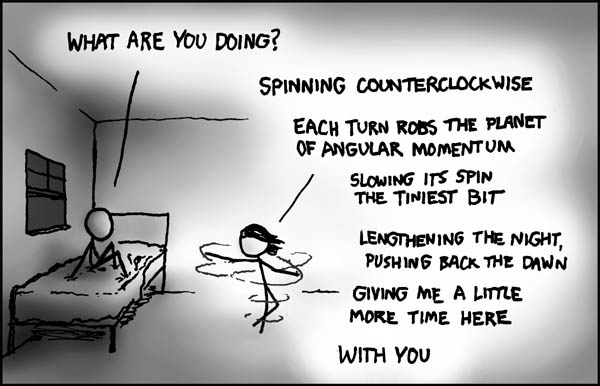
I got a great question from a reader named Sandy. After seeing the xkcd comic titled "Angular Momentum", Sandy wondered:

"...would [it] be possible to work out an estimate of how many people spinning anti-clockwise it would take to counteract the Earth's spin, assuming that the premise is sound."

Great question! First off, the premise is absolutely sound. Anyone who's watched a figure skater speed up when she pulls her legs in has observed angular momentum being conserved. Angular momentum conservation is fancy physics speak for "the universe likes to keep the total amount of spin-y things constant." In this example, as soon as people start spinning, the Earth's rotation will slow down, because the total amount of spin-y things has to be the same.

Admittedly, "spin-y things" is not the most descriptive term, so it helps to have a more formal definition.  It's more difficult to stop an object from spinning when the object is (1) massive and (2) rotating fast.  For this reason, you'd expect the angular momentum of a spinning object to depend on its mass and velocity.  You might also expect it to depend on (3) how the mass is distributed throughout the body, since it's easier to spin a broom stick along its axis (i.e. drill-bit style) than it is to spin it perpendicular to its axis (i.e. helicopter style).  These elements are combined to give an equation for the angular momentum,1 

angular momentum = (mass) · (velocity) · (distance from mass to rotation axis).

A 150 lb. person spinning around once per second would have an angular momentum of about 100 kg·m2/s.  The angular momentum of the Earth is roughly 7×1033 kg·m2/s, so it would take about 7×1031 people to counteract the Earth's spin.  That's 1022 times the actual population, or enough people to cover the surface of the Earth 10 quadrillion times.  

I should point out that even if you stopped the Earth's rotation in this way, it would begin spinning again as soon as everyone stopped rotating, because, as stated earlier, the universe likes to keep the total amount of spin-y things constant.2


[1] I should note that this equation works for point masses rotating around an axis.  If you want the angular momentum for a something that's bigger than a single point, you need to add up a bunch of point masses.  For a spinning person, you could add up the angular momentum of each atom to get the total angular momentum.  In this problem, I've assumed the average atom in a spinning person is a 1 ft away from the axis of rotation and moving at 5 m/s.
[2] If my childhood experience with spinning carnival rides is any indication, I would not want to be around for the ensuing vomit parade that would inevitably follow this worldwide venture.


And...we're back....

I'm back!  Well, I'm for at least a little while until I inevitably get bogged down again.  I'll be posting a few nice estimates over the coming weeks, and we'll hopefully be having another contest or two. 

Thanks for reading and have fun estimating,

-Aaron